Every routine chart on the internet has the same problem. Someone guessed the steps. They look reasonable, they have a cartoon toothbrush next to them, and a week later nobody is following them because they were never your family's routine in the first place.
So before we made a printable, we looked at what parents actually build. Sense has routines built in, and in September 2026 we took every routine families had set up, 920 of them across 267 households, stripped out anything identifying, and counted. The result is not a guess. Nearly every family builds the same three routines, and the steps inside them are remarkably consistent. The printable below is built for those three, and the lists further down are what families actually put in them.
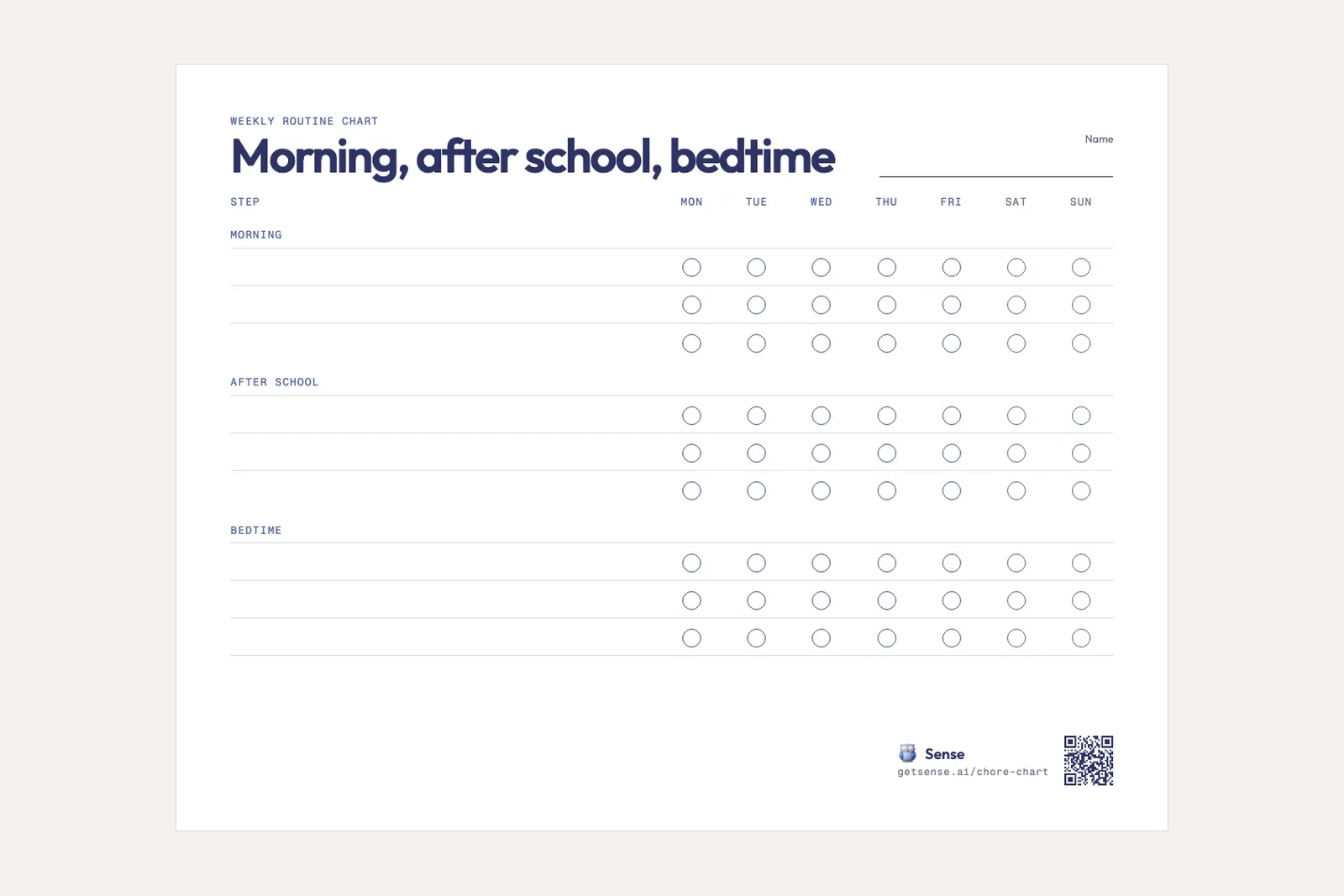
The short version: families build Morning, After School and Bedtime routines and almost nothing else. Morning is the most common by a wide margin. The average routine has four to six steps, most of them hygiene and getting-ready steps rather than chores, and weekends run at about a third of a weekday. The free chart below has a row for each of the three, in US Letter and A4, no email required.
Download the free printable routine chart
The routine chart is page 7 of our free chore chart pack. The pack is eight landscape pages: six chore charts by age from 2 to 18, the blank weekly routine chart with morning, after school and bedtime rows, and a blank chore chart for anything extra. Every page has a ring for each day of the week and a line for the child's name.
Download the PDF (US Letter) or the A4 version. No sign-up. If you want the full by-age lists with notes, they are on the printable chore chart by age page.
The three routines nearly every family builds
Of the 920 routines we counted, 446 are tagged morning, 238 evening and 208 afternoon. The names families give them are even more uniform: "Morning" alone accounts for more routines than every other name combined, then "After school", then "Bedtime". A handful of families have a "Weekend" or a "Sunday reset". Almost nobody has anything else.
Here is what is inside each one, ranked by how many families include the step.
| Routine | Most common steps, in order | Families |
|---|---|---|
| Morning | Brush teeth, get dressed, make bed, eat breakfast, pack backpack, then brush hair, unload the dishwasher, wash face, feed the pet | 115 |
| After school | Homework, read for 30 minutes, clean room, take out the trash, put away clothes, clear the table, practice an instrument, unpack backpack | 63 |
| Bedtime | Brush teeth, pick up toys, read, clear the table, shower, wash face, pack backpack for tomorrow, clothes in the hamper | 70 |
Two things stand out. First, the morning routine is not a chore list. Brush teeth, get dressed and make bed appear in more families than every household job put together. Parents use the chart to get out the door without repeating themselves, and the house comes second. Second, after school is where the actual chores live. If your child has one real job a day, it is most likely to happen between the bus and dinner.
A starter routine you can copy
If you want a starting point rather than a blank page, this is the most common version across families. Write it on the chart, then cross out and add until it matches your house.
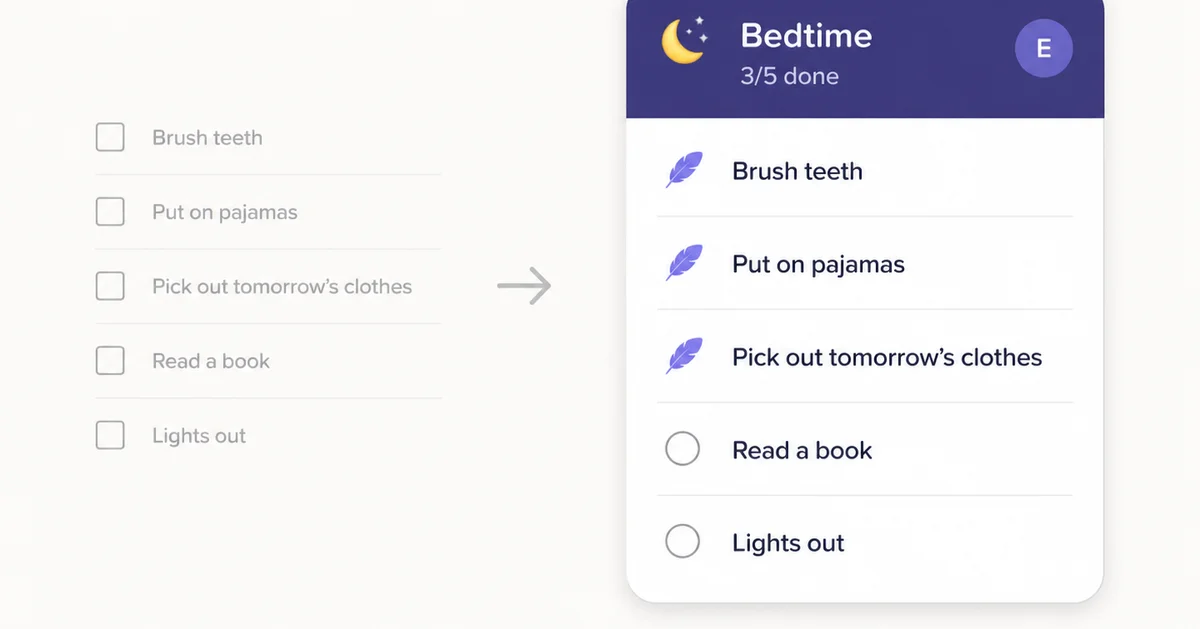
- Morning: get dressed, brush teeth, make bed, eat breakfast, pack backpack
- After school: unpack backpack, homework, read for 30 minutes, one house job
- Bedtime: pick up toys, shower or bath, brush teeth, pack for tomorrow, clothes in the hamper
"One house job" is deliberately vague. In the data it is usually trash, the dishwasher or putting clothes away, and it changes by age. The by-age chore charts show which jobs families assign at each age if you want to fill that slot precisely.
How to use the routine chart
- Print one per child. Letter or A4, landscape. Black and white is fine. Write the name on the line at the top right.
- Keep it to three to five steps per routine. The chart has three rows per routine on purpose. Routines in the data with more than six steps are the ones that stop getting ticked.
- Let the child tick the ring. One ring per day. For kids under 8, ticking is most of the motivation. There is no points column, and most families do not need one.
- Leave weekends light. Saturday and Sunday carry about a third of a weekday's steps across all families. Empty weekend rings are not a failure, they are the norm.
- Reprint on Sunday night. A fresh sheet each week beats a laminated one. Routines change every few months as the child does.
Routine steps by age
The three routines stay the same from 2 to 18. What changes is what goes in them. At 2 and 3 the morning routine is get dressed, brush teeth and pick up toys, and that is the whole chart. At 6 to 8 homework and reading time join the after school routine and the first real chores arrive. By 12 to 14 the after school slot holds whole-house jobs like vacuuming and the bathroom, and by 15 to 18 the bedtime routine gains "ready for tomorrow", meaning pack, charge, lay out clothes. The full lists for each age, with a printable page for each, are on the chore chart by age page.
When the fridge sheet stops working
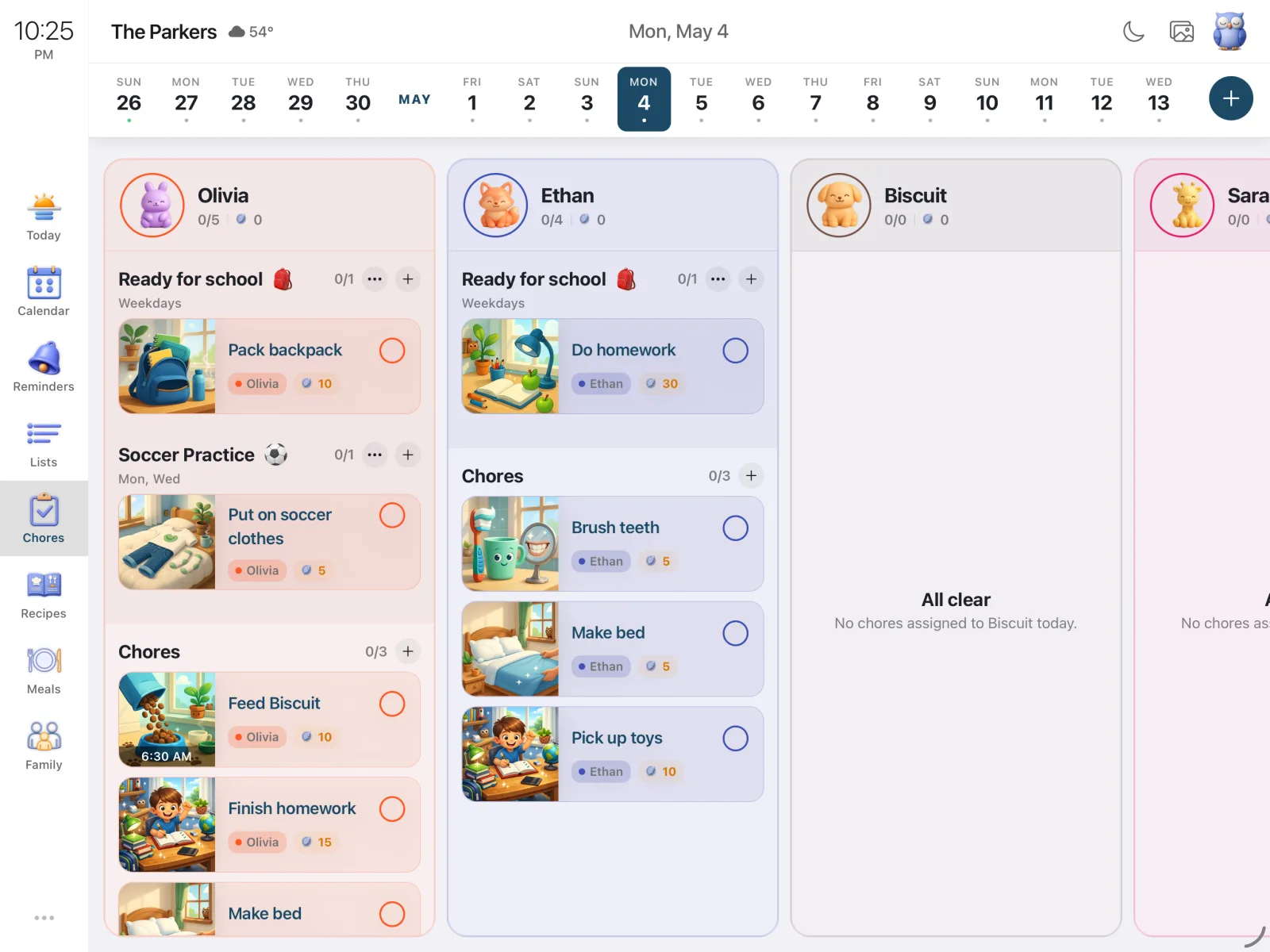
Paper routines fail the same way every time: the rings stop by Wednesday and the other parent still asks what the kids are supposed to do. Sense runs the same three routines on the family tablet and your phone, repeats them on the days you set, and shows each child their own list. Tell it "set up a morning routine for Maya with get dressed, brush teeth, make bed, breakfast and pack backpack" and it builds it.


Common questions
What is the difference between a routine chart and a chore chart?
A routine chart is a sequence of steps a child does at the same time each day: get dressed, brush teeth, make bed. A chore chart is a list of jobs, often shared across the household. In practice most families blend them. Half of all chores in our data live inside a morning, after school or bedtime routine, which is why the pack has both.
What age can kids start using a routine chart?
The youngest children on a routine chart in our data are 2. At 2 and 3 the chart is three or four steps with no household jobs: get dressed, brush teeth, pick up toys, pajamas on. Make bed and clear the table arrive at 4 to 5.
How many steps should a kid's routine have?
Morning routines in the data most often have four to six steps, after school three to four, bedtime four to five. Shorter routines get completed. If you are choosing between a complete list and a short one, choose short.
Do I need rewards for a routine chart to work?
About a third of routine steps in the data carry no points at all, and where points exist the most common value is 5 and it barely rises with age. Ticking the ring is most of the motivation for younger kids. The printable has no points column so you can decide.
Is the printable routine chart free, and do I need to give an email?
Yes, and no. The download links above go straight to the PDF in US Letter or A4. There is no form.