
2026 has been the year "AI agent" went mainstream. There are coding agents that write and ship software, customer-service agents that close tickets, research agents that read a hundred documents and hand back a summary. The pitch behind all of them is the same: this isn't a chatbot you have to babysit. It's software that does the work.
Notice where all of that effort has been pointed. At work. At code, at sales, at spreadsheets. Meanwhile the most relentless operations job most people have doesn't happen at an office. It happens at home, and it usually runs through one person's head.
Someone has to know that picture day is Tuesday, that the permission slip is due Friday, that soccer moved to a different field, and that there's nothing thawed for dinner. That person reads every school email, remembers every deadline, and gets asked "what do I need to bring?" fifteen times a week. That is the job an agent should have taken first. It's finally starting to.

Quick Summary
- An agent acts, a chatbot answers. A family AI agent doesn't just respond to questions - it does the multi-step work and hands you the result.
- It reads the chaos so you don't have to. School emails, screenshots, forwarded PDFs, class group messages - it pulls out the one date buried in paragraph four.
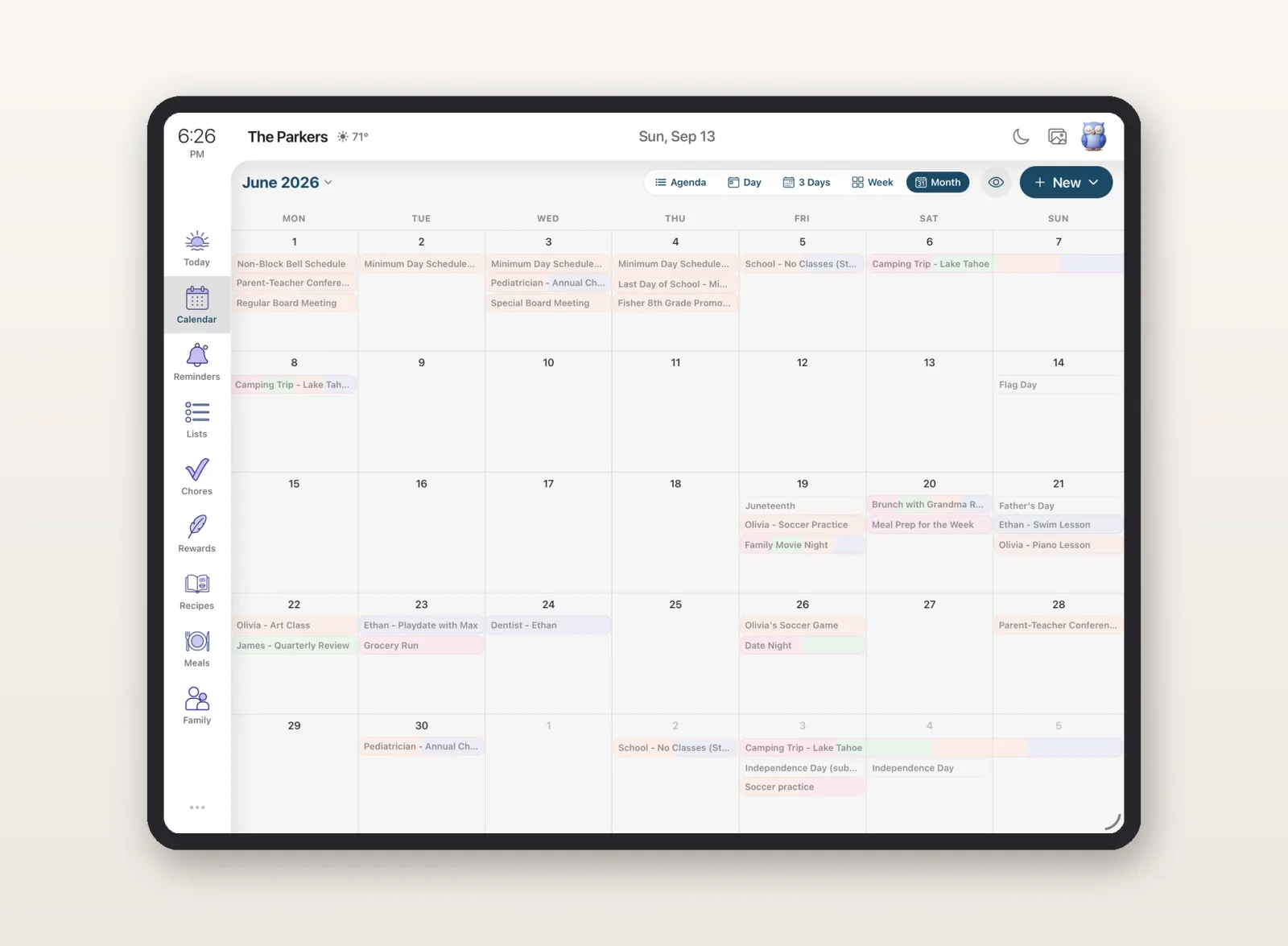
- It files, not just finds. The event lands on the calendar, with the reminder set and the right kid tagged, shared with your partner automatically.
- The goal isn't a smarter app. It's removing you as the single person who has to process everything.
- Sense is a family AI agent built around exactly that job. Try it free in your browser.
Assistant vs. agent: the difference that matters
Most people's mental model of "AI" is a chatbot: you type a question, it types an answer. That's an assistant. Useful, but the work still lands on you. You asked what's for dinner; now you still have to shop, prep, and cook.
An agent is different. You hand it a goal or a raw input, and it figures out the steps and carries them out. It reads, it decides, it takes action, and it comes back when the thing is actually done.
Here's the difference in family terms:
- An assistant answers "what's on the calendar Thursday?"
- An agent notices the coach emailed a schedule change, updates Thursday's game time, moves your reminder, and lets your partner know - before you even open the email.
You can still talk to an agent like a chatbot. The difference is that behind the conversation, it's actually running your logistics, not just describing them.
What a family AI agent actually does
Strip away the buzzwords and a family AI agent does four concrete things.
1. It reads the things you don't have time to read
Family information doesn't arrive as tidy calendar invites. It arrives as a 900-word school newsletter, a coach's group text, a screenshot of a birthday invite, a PDF of the swim schedule, a WhatsApp thread from the class parent. The one date that matters is usually buried three paragraphs deep, next to four that don't.
A family AI agent reads all of it the way you would if you had the time - and pulls out what's actually actionable. Dates, times, locations, deadlines, what to bring, which kid it's for.
2. It files, it doesn't just find
This is the line between a search tool and an agent. It's not enough to find the date. The agent creates the event, adds the location, sets a reminder at a sensible time, tags the right child, and shares it so both parents can see it with full context. You didn't open the calendar. You didn't type anything. The work happened.
3. It remembers how your family actually runs
Good agents hold context. Soccer is every Tuesday and Thursday. Your youngest goes to bed at 7:30. You don't want two things booked against each other on a Saturday morning. Over time, a family AI agent works within those standing rules instead of treating every input as a blank slate, so what it files fits the life you actually live.
4. It answers in plain language
The assistant part doesn't disappear - it just sits on top of a calendar the agent actually maintains. "What does Mia have this week?" "Is anyone free Saturday afternoon?" "Add a dentist reminder for both kids." You ask the way you'd ask a partner who's been paying attention. And because the agent has been keeping the schedule current, the answer is right.
What a family AI agent does not do (and shouldn't)
The hype around AI agents tends to promise everything. It's worth being just as clear about what a good one leaves alone.
It doesn't make the judgment calls. It won't decide whether your kid is ready to quit piano, or whether Saturday is too packed. It handles the logistics so you have the space to make the calls that are actually yours to make.
It doesn't ask you to feed it your whole life. The point of an agent is less input, not more. If a tool needs you to carefully enter, tag, and maintain everything before it helps, that's a system, and you already have too many of those. A family AI agent works off the messages and forwards that were already landing in your inbox.
It isn't surveillance. Handing software your family's schedule only works if you trust where that information goes. That means no ads, no selling your data, and no advertisers in the loop. The whole value is that it quietly runs your household, not that it mines it.
It won't "10x your family." You're not trying to optimize dinner or turn your kids into a productivity funnel. The goal is smaller and more human: get the logistics out of your head so you can be present for the parts that matter. An agent that respects that is worth having. One that wants to gamify your Tuesday is not.
Why the family was the last place to get an agent
If home logistics is such an obvious job for automation, why did work get agents first?
Part of it is data. Work runs on structured information - calendars, tickets, CRM records, code. Family life runs on the opposite: messy natural language arriving from a dozen unrelated sources, each with its own format and its own idea of where to hide the important detail. For years, software simply couldn't read that mess. It needed you to translate it into fields.
That's the piece that changed. Modern AI is finally good at exactly the thing family logistics is made of: reading unstructured, human, chaotic language and understanding what it means. The technology caught up to the mess.
The other part is that nobody was building for her. The person carrying the household's logistics has been offered calendar after calendar after shared spreadsheet, all of which assume the hard part is typing things in. It never was. The hard part is being the only one who has to read, process, and remember all of it. A family AI agent is the first kind of tool aimed at that specific problem.
What it feels like when it works
The measure of a family AI agent isn't a feature list. It's a quiet week.
You forward the coach's email from the pickup line and don't read it. The game lands on the calendar, the reminder is set, and your partner sees it too. On Tuesday morning, nobody asks you where soccer is. Picture day is Thursday, and you already knew, and so did he. You didn't organize anything. It just got handled.
That's the real shift. Not that you become more organized - you were always organized, that's the trap. It's that you stop being the single point of failure. The schedule lives somewhere the whole family can read it, instead of only in your head.
Getting your own family AI agent
Sense is a family AI agent built around one job: getting what's in your inbox and your head out of your head, and into a place your whole family can see.
You forward a school email, a screenshot, or a photo of the flyer on the fridge. Sense reads it, pulls out the events and deadlines, and files them on a shared family calendar with reminders set and the right kid tagged. You can ask it questions in plain language, plan the week's meals, split the chores, and keep the whole household in one quiet place instead of seven pinging apps.
The best way to understand what an agent feels like is to hand it something messy and watch it work. Forward your next school or activity email and see what comes back.
Try Sense Free, No App Install Needed
Open Sense in your browser and forward your first email. Events appear on your calendar in seconds.
Try Sense Online or get the app: