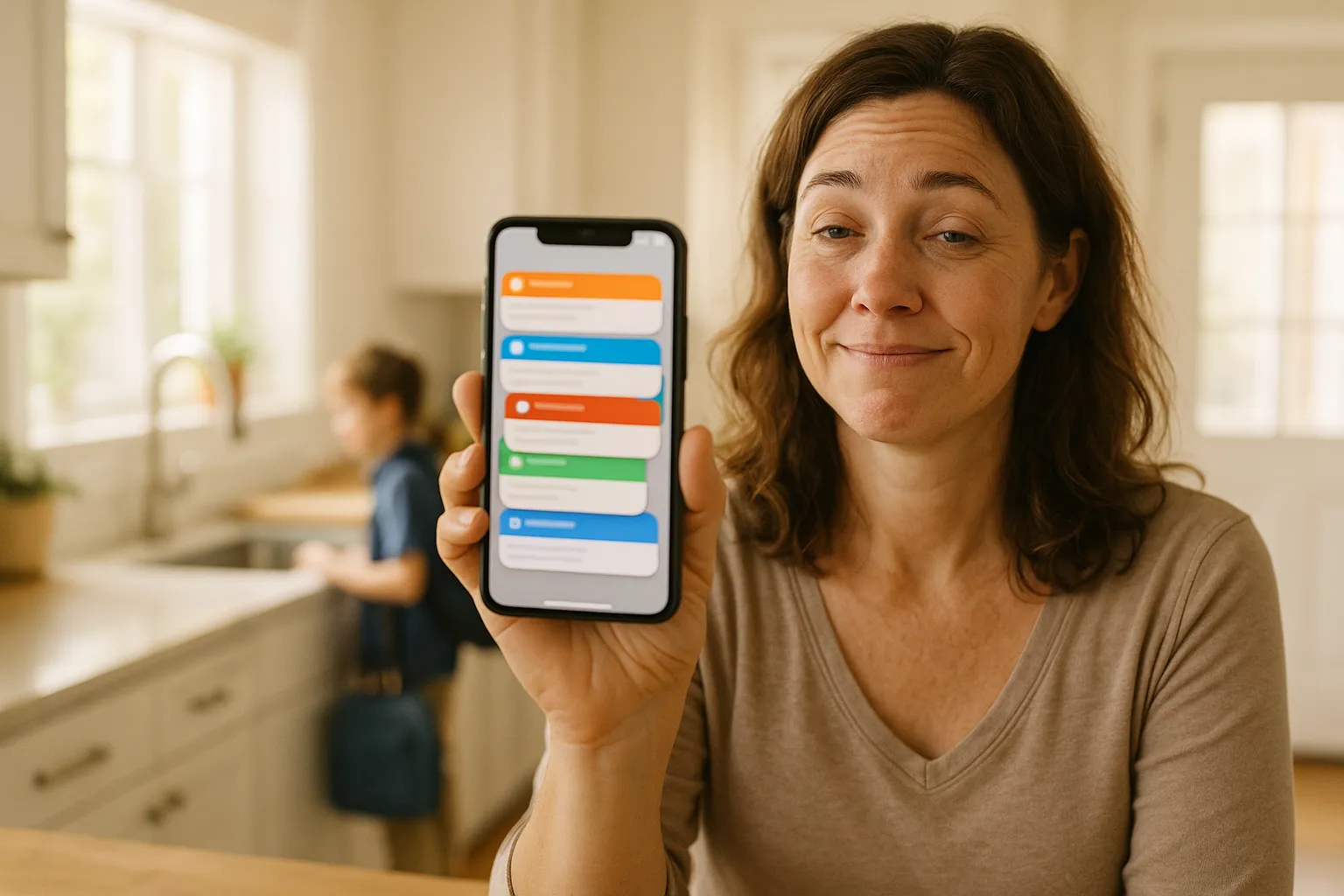


The kid starts kindergarten and your personal inbox quietly turns into a second work inbox. The district emails. The school emails. The teacher emails. The room parent, the PTA, the after-school program. Within a week you're getting more mail about a five-year-old's schedule than you get about your actual job.
Most advice about this points at you. Set up filters. Be more disciplined. Check email at a set time. All fine, none of it addresses the part that actually wears you down.
The volume is annoying. The format is the problem.
Twenty emails a day is a nuisance you could learn to skim. The reason school email feels heavier than that is that the thing you need is never the thing you're reading. It's tucked inside it.
A cheerful newsletter with one date that matters in the fourth paragraph. A "quick reminder" that turns out to be your only notice of a half day. A closure buried inside a PDF attachment nobody opens, which is how a parent ends up in an empty school parking lot on a morning that was clearly marked, somewhere, as a day off.
"Welcome back! A few notes: picture day is next Thursday, please send the signed device agreement by Friday, Spirit Week starts the 15th (Monday is pajamas), and don't forget water bottles now that we're on a boil order."
That's not a message. That's a date, a task with a deadline, a five-part costume schedule, and a logistics change - stapled together and written in the order that made sense to the sender, not to you. Reading it isn't the work. Taking it apart is the work. And you do that decoding a dozen times a day, mostly on your phone, mostly while doing something else.
The shift: sort, don't read
The parents who aren't drowning mostly stopped treating school email as reading and started treating it as an intake pile. Open a message once and put it into one of three buckets:
- A date. Picture day, the half day, the field trip, the sign-up deadline. It goes on the calendar right now, while it's in front of you - not after dinner, when you've forgotten half of it.
- A task. Sign the form, send the $30, pack the white shirt. It gets a due date, even if the thing itself happens later. The deadline is the event.
- An FYI. The principal's weekly note, the reaffirm-your-address message, the ice cream Friday announcement you can act on Thursday. You're allowed to let these wash past.
The relief here is smaller and more honest than "inbox zero." It's that a visible pile beats an invisible one. Once every email has resolved into a date, a task, or nothing, the low background hum of I think I'm forgetting something gets quieter, because you can actually see what's left.
None of this requires an app. A label in Gmail you check twice a week, a note on the fridge, a shared calendar you both trust - any of it works, as long as the decoding step actually happens.
Why it still lands on one person
Here's where the honest part comes in. The sorting works right up until it becomes a standing job that belongs to exactly one parent. School email quietly appoints a household's information manager, and that person spends the year holding dates in their head, forwarding the important ones, and being the only one who knows that Tuesday is a half day.
That's why "just read your email" is bad advice for a two-parent house. The goal isn't for one of you to become better at triage. It's for the output of the triage - the dates, the deadlines, the who's-doing-pickup - to live somewhere you can both see without asking each other. Sorting into your own head doesn't share the load. It concentrates it.
Where Sense fits
Sense does the decoding step for you. You forward a school email to share@getsense.ai (or set the school to send there directly), and it pulls out the dates, the deadlines, and the details - picture day, the permission slip and what it costs, each theme day as its own entry - and puts them on a family calendar. Here's what actually gets picked up if you want to see the parsing.
If most of your school email comes through one platform, there's a guide for it: ParentSquare, SchoolMessenger, Smore newsletters, and in the UK ParentMail, Arbor and Edulink One.
Two things matter more than the extraction. First, it isn't only the calendar: a reminder to sign the form, an item added to a shared list, a birthday you'd otherwise learn about the morning of - the whole spread of what a school email asks of you, not just the dates. Second, what comes out is shared by default. Put the family display on an old iPad on the counter and the other parent doesn't have to open anything or get nagged - the week is just there, on the wall, for whoever walks past.
It doesn't make the school send less. It takes the part you keep failing to do when you're busy - the manual re-typing of a date you already read - off your plate, so a missed email stops turning into a missed morning.
Kindergarten is the year you realize running a family's logistics is a part-time job nobody interviewed you for. You can't hand back the job. You can stop doing the most tedious part of it by hand.