

Quick Take
- Back-to-school overwhelm is not a memory problem. A summer's worth of school communication arrives in about three weeks, from a dozen senders, with the one date you need buried in paragraph four.
- The shared calendar you set up in July does not help, because the school still emails one parent and nothing on that calendar filled itself in. The intake step is the step you keep failing at.
- Set up an inbox that reads the emails for you before the first welcome packet lands. Forward it once, and picture day, the forms deadline, and the early-dismissal date land on the calendar without you typing a thing.
It is the second week of August. The pool bag is still by the door. And then your phone buzzes with the email you have been half-dreading since June:
"Welcome to the 2026-2027 school year! We can't wait to see everyone."
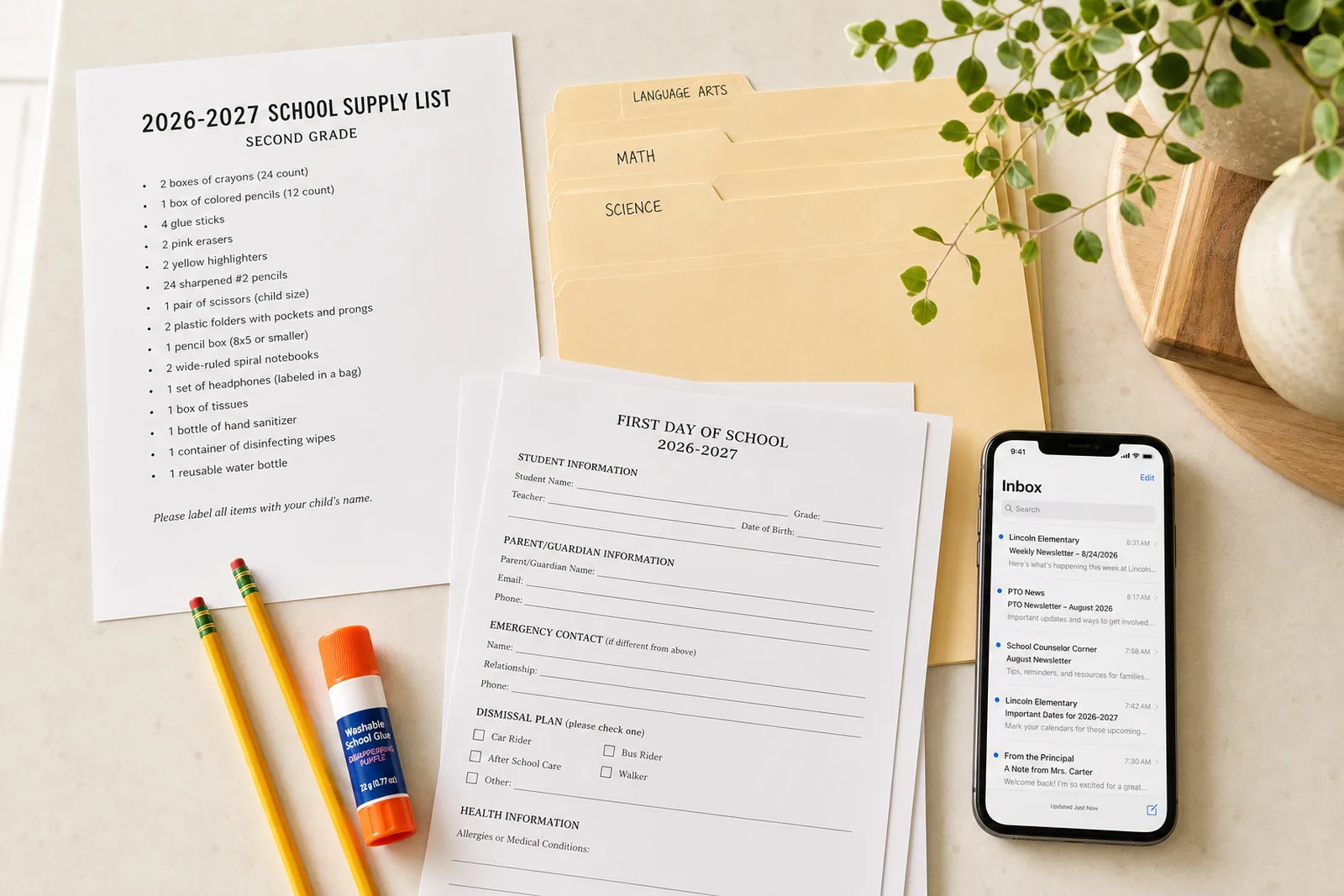
You know what that email means. It is not one email. It is the first flake of the avalanche. Over the next three weeks, your inbox is going to fill with supply lists, health forms, spirit-wear order windows, bus route assignments, a first-day schedule that is different from the regular schedule, a media-release form you have to sign twice, a back-to-school-night date that conflicts with soccer eval, and a PTA sign-up that somehow already feels like a guilt trip.
You have done this before. You are not new here. You have a shared Google Calendar with your partner. You made a Target run. You are, by any reasonable definition, on top of it. And you will still be standing in the kitchen on the second Tuesday of September realizing that today was early dismissal and nobody arranged pickup.
Here is the thing about the back-to-school avalanche: it is completely predictable. And that is the one thing working in your favor.
The problem was never planning. It is intake.
Every "get ready for school" article you have ever bookmarked assumes the hard part is planning ahead. Make a command center. Prep the launch pad. Lay out the outfits Sunday night. Do a weekly reset.
But you cannot plan ahead for information you do not have yet. In early August you do not know your kid's teacher, the classroom supply list, the bus number, the half-days, or which Friday is the first spirit day. All of that is sitting on a server at the school, waiting to be emailed to you one dense message at a time.
So the real work of back-to-school is not planning. It is intake: catching each piece of information the moment it arrives, pulling the date or the deadline out of the paragraph it is buried in, and getting it somewhere the whole family can see it. Do that reliably and the fall runs itself. Fail at it once and you are the parent who missed the forms deadline and got the "please submit by end of day" reminder in front of everyone on the class list.
Almost every family app on the market is built for the planning half. They give you a beautiful calendar and expect you to type the events in. But typing the event in is the exact step you keep failing at in late August, because there are forty of them and they all arrived this week.
The five waves of the back-to-school avalanche
It helps to name what is coming. The flood is not random. It arrives in five recognizable waves, each with its own trap.
Wave 1: The welcome packet
"Welcome back! The first day of school is Wednesday, August 27. Please note this is an early-release day, with dismissal at 12:15 PM. Kindergarten families: your child's teacher assignment and classroom will be posted on the parent portal on August 22. Bus routes are attached (PDF). Please review the attached first-week schedule, which differs from our regular bell times."
The trap: The first day is not the first normal day. It is an early release, on a Wednesday, with a schedule that looks nothing like the rest of the year. The one sentence that will actually derail your week - "dismissal at 12:15 PM" - is sitting in the middle of a cheerful welcome note, and by the time you have skimmed to the bus PDF you have already forgotten it. This is the email that produces the September moment where you are at your desk at noon realizing school got out two hours ago.
Wave 2: The forms blitz
"Before the first day, please complete the following in the parent portal: Emergency Contact Card, Photo/Media Release, Health & Allergy Form, Acceptable Use (technology) Agreement, and the Free/Reduced Lunch application. Paper forms will not be accepted. All items are due by Friday, August 22."
The trap: Five forms, one deadline, one portal login you have not used since June and cannot remember the password for. None of them are hard on their own. Together they are a forty-minute task that requires you to find your kid's doctor's phone number, your emergency backup's new address, and a decision about whether the media release is a yes or a no this year. And the deadline is before the first day, which feels far away until it is tomorrow.
Wave 3: The supply-and-money list
"Attached is the classroom supply list for Ms. Alvarez's third grade. Please label all items. Spirit-wear orders are open through September 5. Book Fair is the week of September 15. PTA membership is $15 per family. Fall fundraiser packets will come home the first week."
The trap: This wave costs money and has multiple small windows, none of which are urgent enough to act on immediately and all of which will close before you circle back. The supply list has a specific brand of glue stick the teacher actually wants. Spirit wear closes September 5. Book Fair needs cash on a specific day. Each is a five-minute task with a deadline, which is precisely the kind of thing that falls through the cracks between the bigger fires.
Wave 4: The calendar dump
"Please add these dates to your calendar: Back-to-School Night is Thursday, September 4 at 6:30 PM. Picture Day is Tuesday, September 16. Early dismissal every Wednesday begins September 10. No school September 1 (Labor Day) or September 29 (teacher in-service). Parent-teacher conferences will be scheduled for the week of October 20."
The trap: "Please add these dates to your calendar" is the single most optimistic sentence a school sends all year. It assumes you will stop, open your calendar, and hand-enter six events, three of which recur and one of which - the weekly Wednesday early dismissal - will quietly wreck your childcare arrangement every single week if it does not make it in. You mean to. You are reading this on your phone in the pickup line. You will do it tonight. You will not do it tonight.
Wave 5: The activity sign-ups
"Fall soccer registration closes August 30. Chess club meets Tuesdays after school starting September 9, sign up by September 2. Band families: instrument rental night is August 28, 5 to 7 PM. After-care spots are limited and filling fast - register now to secure your place."
The trap: These come from outside the school entirely - the rec league, the club coordinator, the music teacher, the after-care provider - so they do not even live in the same inbox thread. Every one has a hard registration cutoff, and "filling fast" is often true. Miss the after-care window and your entire fall childcare plan changes. This is the wave that turns a scheduling problem into a logistics emergency.
Why the calendar you shared in July won't save you
You did the responsible thing. Sometime this summer you and your partner shared a Google Calendar, or you resubscribed to Cozi, or you bought the wall calendar with the family-color pens. Good. That is the container. But a container does not fill itself.
Every one of the five waves above lands as an email in one inbox - usually yours, because you are the parent whose address the front office has on file. The calendar does not know the email arrived. It sits there, empty, waiting for you to read the message, find the date in paragraph four, and type it in. Sharing the calendar with your partner did not share the reading. It just gave both of you a view of the events you personally still have to enter.
The mental load of back-to-school is not the calendar. It is the forty acts of translation between the email and the calendar, and you are the only one doing them.
This is why every August feels the same no matter how organized you are. Organization is not the constraint. You are extremely organized. The constraint is that you are a human bottleneck sitting between a firehose of school email and a calendar that only updates when you personally move information across the gap. Add a second kid and the firehose doubles. Add a spouse who "didn't see that email" and you are also the help desk.
What actually works: let the inbox fill the calendar
The fix is not another planner and it is not more discipline. It is to remove the translation step entirely - to let the emails populate the calendar themselves, so that reading the welcome packet is the same action as scheduling everything in it.
Concretely, that means an inbox that does four things you are currently doing by hand:
- Reads the whole email, including the six-page newsletter, and finds every date and deadline in it - not just the one in the subject line.
- Turns those into calendar events with the texture attached: early dismissal at 12:15, picture day forms due first, $15 PTA cash, the specific brand of glue stick.
- Sets reminders on the deadlines, so the forms-due-Friday and the spirit-wear-closes-September-5 get a nudge before they close, not a "sorry you missed it" after.
- Shows it to every adult at once, so your partner is looking at the same early-dismissal Wednesdays you are, without you forwarding anything or narrating it on Sunday night.
Do that, and the avalanche stops being an avalanche. Each email still arrives. But instead of adding a task to your list, it adds an event to the family's calendar on its own. Your job shrinks from "process forty emails into forty calendar entries before someone misses something" to "glance at the calendar and confirm it looks right."
How Sense handles the back-to-school avalanche
This is the exact problem Sense was built for. It is a family organizer whose primary input is not typing - it is forwarding.
You get a family inbox address. When the welcome packet lands, you forward it to share@getsense.ai. Sense reads the whole thing, pulls out the first day, the 12:15 early release, the bus route, and the portal-posting date, and puts them on a shared calendar that every adult in your family can see. When the forms blitz arrives, forward it - the Friday deadline gets a reminder. When the calendar dump comes, forward it once and back-to-school night, picture day, the recurring Wednesday early dismissals, and the no-school days all appear at the same time. When the after-care email lands from a provider that is not even the school, forward that too. Same inbox, same calendar, same result.
You are not typing events. You are not the translator. And you are not the only one who knows that this Wednesday is a half day, because it is on the calendar your partner is also looking at.
None of this requires you to plan the fall in advance, which is good, because you cannot. It just requires you to have the inbox set up before the first email arrives. That is the one genuinely time-sensitive back-to-school task: do it in early August, and the rest of the season fills itself in as it comes.
Set it up before the welcome packet lands.
Forward the school emails once. Sense reads them and puts the dates, deadlines, and reminders on a calendar the whole family shares. You stop being the bottleneck between the inbox and the fall.


Related reading: 5 school emails every parent dreads · Can AI actually read a school newsletter? We tested one · The mental load of family coordination · How email-to-calendar works