
Quick Take
- Search "co-parenting app" and you get OurFamilyWizard, TalkingParents, and AppClose - all built for high-conflict legal cases, not for shared calendars.
- Sharing a Google Calendar doesn't fix the real problem. The school still only emails one parent. The coach still only texts one parent. The kid is still the courier between two houses.
- A two-household calendar only works if the source material - school emails, coach updates, party Evites - flows to both households automatically, with all the texture intact.
It's 7:14 PM on a Sunday. Your daughter just got dropped off after a weekend at her dad's. You're folding her hoodie back into the drawer when she mentions, almost as an afterthought:
"Oh, I need a green shirt tomorrow. For the field trip."
You stop. "What field trip?"
She shrugs. "The aquarium. Dad signed the form."
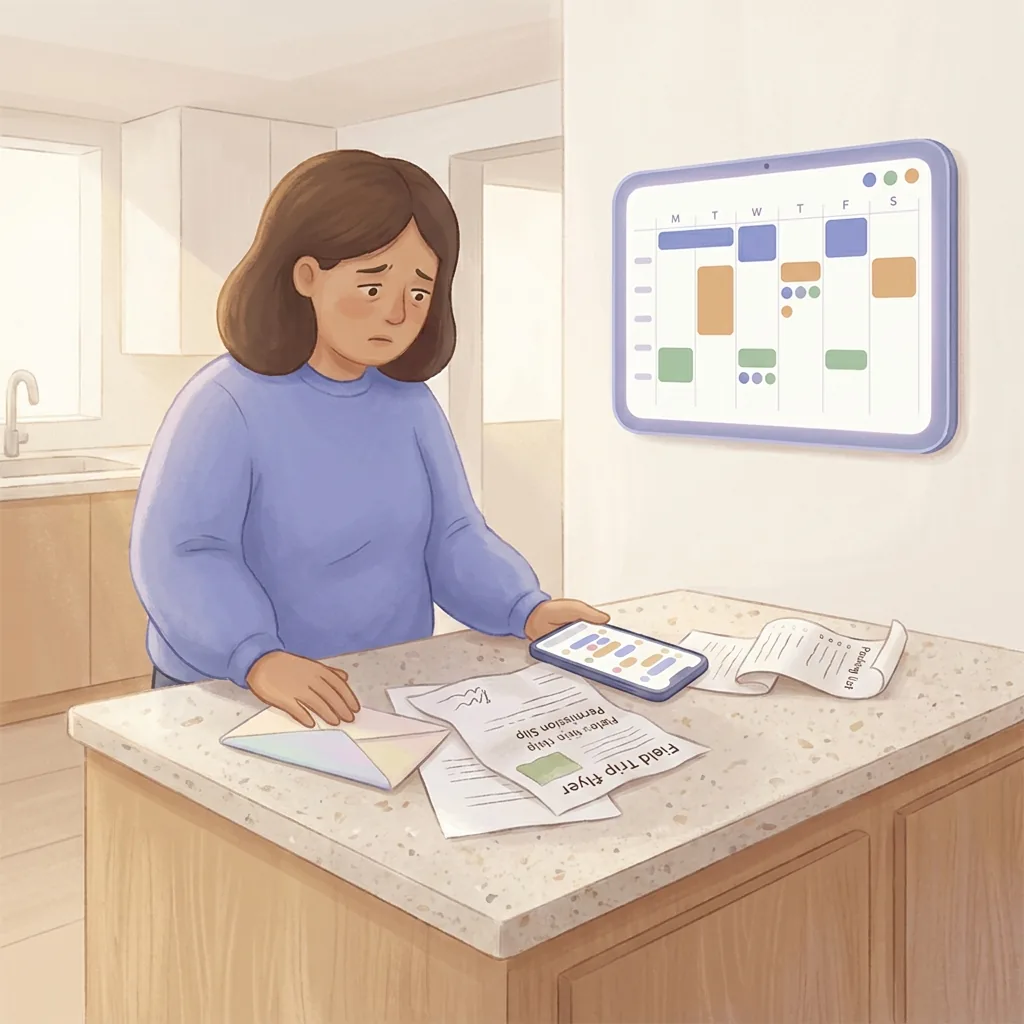
You open your email. Nothing. You check the school portal. There's a permission slip there from ten days ago, unsigned - because her dad signed a paper copy that came home in her backpack two Fridays ago. Pickup is 7:45 AM at the side entrance, not the front. Bag lunch. Two dollars cash. No phones.
You don't own a green shirt. You'll be at Target at 6:30 AM.
This is what shared calendars for co-parents actually fail at. Not the events themselves - the field trip is on someone's calendar somewhere. It's the texture: the permission slip, the side entrance, the green shirt, the two dollars cash. The stuff that lives in the email that only went to one parent.
Most co-parenting apps were built for court, not for calendars
Search "co-parenting app" and the results are dominated by tools that were not built for what most co-parents actually need.
OurFamilyWizard. TalkingParents. AppClose. They're priced like legal software ($99 to $144 per year), they timestamp every message, they log who edited what and when, and they market themselves as court-admissible. Many were built because judges actually order them: "Communicate through TalkingParents only."
For high-conflict cases - active litigation, restraining orders, documentation needs - these are the right tools. They exist for good reasons, and they're excellent at what they do.
But somewhere along the way, "co-parenting app" got equated with "court-approved app." If you go looking for a calendar to share with your ex, every roundup, every Reddit thread, every Best Co-Parenting Apps listicle steers you toward tools designed for the worst case.
Most co-parents are not in active litigation. They're tired, they're cordial-but-not-friendly, and they just want their kid's schedule to flow between two houses without one parent having to text the other a play-by-play every Sunday night. They don't need an audit log. They need a calendar.
"Just share your Google calendars" doesn't actually work
The default suggestion from every well-meaning friend: just share your Google calendars with each other.
It sounds reasonable for ten minutes. Then you hit the real problems.
The school still only emails one parent. Whichever email address the front office has on file is where the field trip permission slip, the picture day reminder, the early dismissal alert, and the parent-teacher conference signup all land. Sharing a calendar doesn't change that. The email lands in one inbox, and unless that parent takes ten minutes to manually transcribe everything, the other parent is operating blind.
Coaches text only one parent. The 9 PM Tuesday text from Coach Mike saying practice is cancelled tomorrow because the field is wet - that went to whichever number is in the team roster. The other parent finds out when they drive the kid to a closed field.
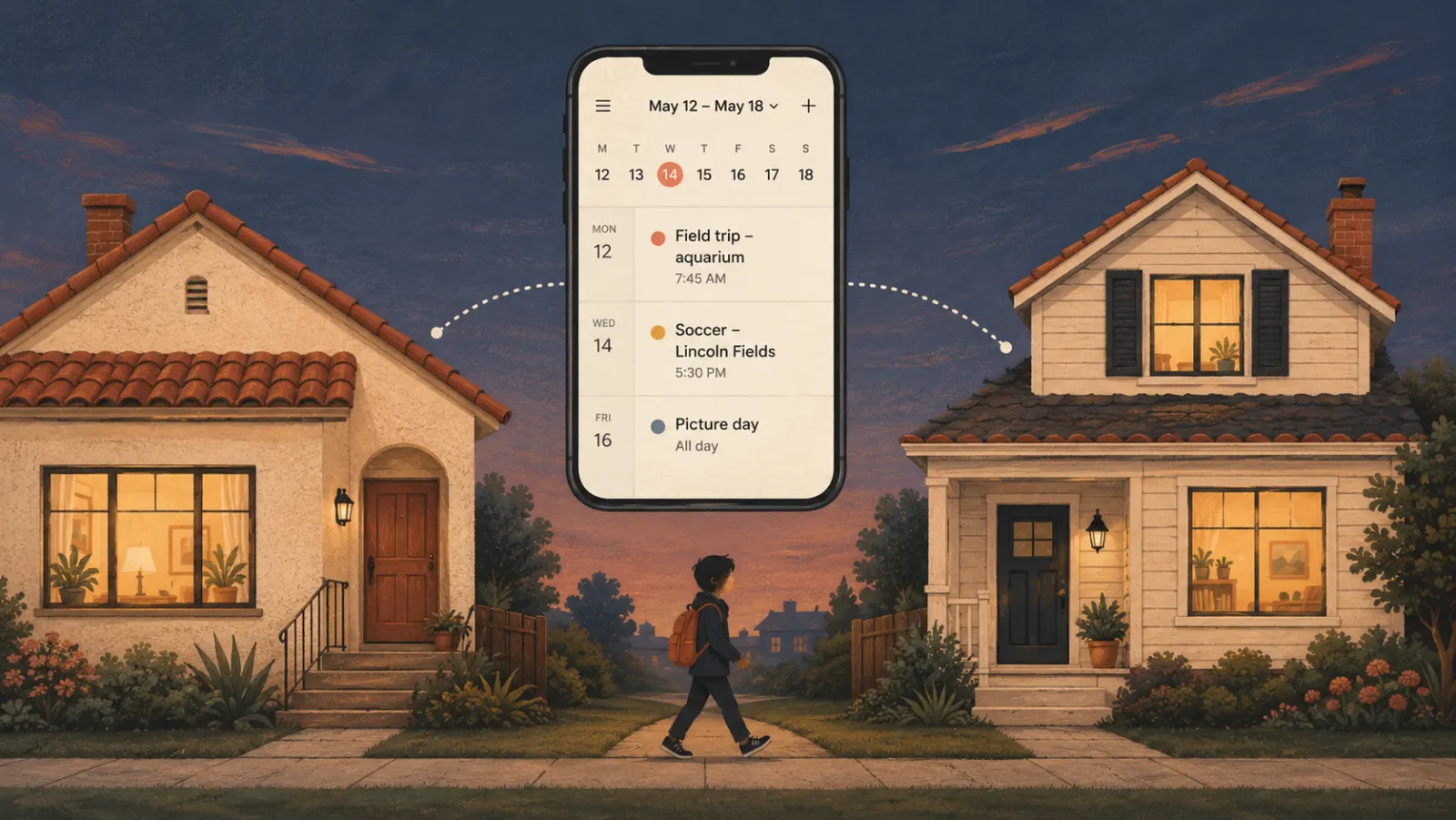
The kid becomes the courier. "Mom said I need a costume for Friday." "Dad already signed the permission slip." Kids carry information across households the way medieval messengers carried letters: intermittently, incompletely, and with details garbled. Permission slips get signed twice. Items get packed at the wrong house. Conferences get attended by no one.
"Did you add it to the calendar?" becomes the whole conversation. Even with Google Calendar sharing turned on, somebody still has to do the data entry. That somebody is almost always the same parent - the one who reads the school emails, the one the coaches text, the one whose number is on the emergency form. The mental load doesn't get shared. It just gets re-routed through a calendar.
The information lives in inboxes, not on calendars
This is the part almost every co-parenting app gets wrong: they assume the source of truth is the calendar. So they invest in better calendar interfaces, color-coded custody schedules, swap-week visualizations, and Sundays-with-Mom-Wednesdays-with-Dad rotation views.
But the actual source of truth for a kid's life is a stream of messages:
- The school's weekly newsletter
- The PTA flyer that says it's spirit week
- The coach's "practice moved" text
- The orthodontist's appointment confirmation
- The birthday party Evite
- The camp packing list
Every one of those messages lands in one parent's inbox. None of them auto-populate the shared Google calendar. None of them ping the other parent. And every one of them has the texture - the side entrance, the green shirt, the two dollars - that disappears the moment somebody summarizes it as "Field trip, 9 AM" on a calendar grid.
A two-household calendar is only as good as the information flowing into it. If only one parent gets the email, only one parent has the context. The calendar is downstream.
What information equality across two houses actually looks like
Here is what a shared calendar for co-parents should actually do:
Both parents receive the same source material at the same moment
If the school sends a permission slip, both parents should see it - not because one parent forwarded it, but because the family inbox is shared by design. No translator. No middleman.
Context travels with the event
"Field trip 9 AM" is useless. "Field trip 9 AM, side entrance, green shirt, $2 cash, permission slip due Friday" is the event. The details belong on the event, not in someone's head.
Updates ripple to both households automatically
Coach moves practice from Tuesday to Wednesday. The event updates on both parents' calendars. Neither parent has to text the other a screenshot. Neither parent finds out at a closed field.
The kid is not the courier
A nine-year-old should not be responsible for synchronizing information across two adult households. They will fail. It is not their job, and it is not fair.
Blended families: three or four adults, one schedule
The co-parent calendar problem gets sharper in blended families.
Now there are not two adults coordinating a kid's life - sometimes there are three or four. Two biological parents. A stepmom. A stepdad. Maybe a grandparent on Wednesday pickups. The kid might share a roof with two or three half-siblings, each on a different custody schedule with different houses.
Most co-parenting apps simply cannot model this. They were built on the assumption of exactly two adults sitting across from each other. Add a stepparent and you're outside the product.
This is where a family-organizer model - rather than a co-parent-app model - starts to fit. The unit is not "the two legal parents." It is "the adults responsible for this kid this week." Some of those adults live in House A, some in House B, some are step-relatives, some are grandparents on rotation. They all need the same information. None of them are inherently in opposition to any of the others.
A shared family calendar that supports more than two grownups, and treats stepparents as full participants instead of an afterthought, looks very different from a two-column court-friendly app.
A calendar that doesn't take sides
There is one more thing worth saying out loud.
Court-approved co-parenting apps were designed for a relationship that needs evidence. Every message is logged. Every edit is timestamped. The product is, structurally, a referee.
If your co-parenting relationship is in that place, you need that. Don't let anyone talk you out of it.
But most co-parenting relationships are not in that place. Most are tired, cordial, sometimes awkward, and trying their best. Imposing a referee on a relationship that doesn't need one adds friction. It frames every routine handoff as adversarial. It treats every calendar invite as a piece of potential evidence.
A calendar should not take sides. It should just show whose Wednesday is whose, what time pickup is, where the field trip is leaving from, and what color shirt the kid needs.
If you want the audit log, get the audit log. If you just want both households on the same page about the green shirt, you don't need a court order. You need a calendar.
How Sense handles two-household families
Sense is a family organizer, not a co-parenting app. The distinction is the point.
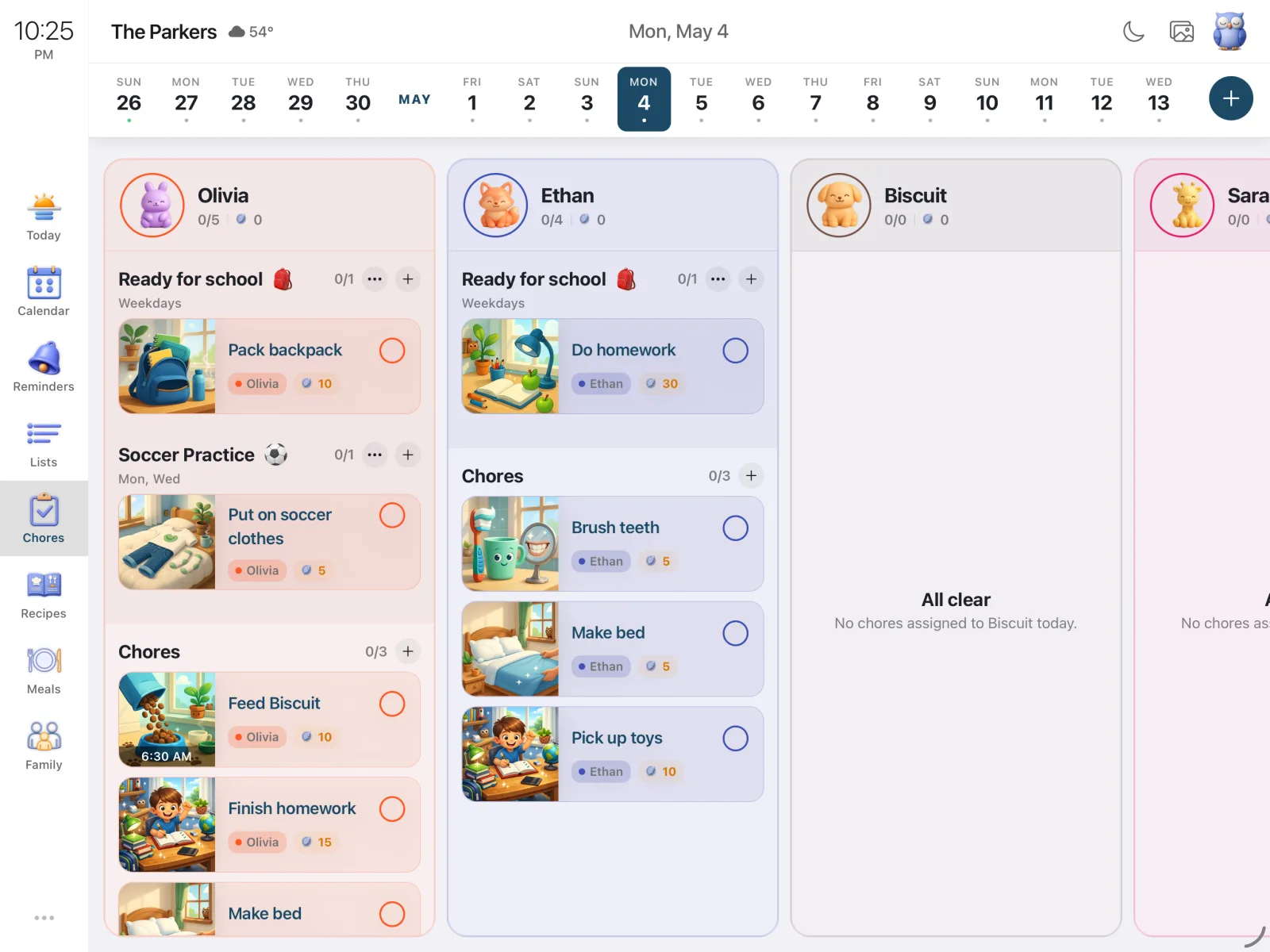
Both households' adults sit on the same family. School emails forwarded once flow to everyone. The AI extracts the date, the time, the location, the gear, the deadline, and creates events visible to every adult - both biological parents, stepparents, grandparents on the Wednesday rotation. Custody handoffs become routine recurring events on the calendar, color-coded by household. The information equality works the same way it would in a single-household family: nobody is the gatekeeper because the gate doesn't exist.
It works for amicable co-parents. It works for blended families with stepparents in the mix. It works for grandparents who pick up on Tuesdays. It does not work for high-conflict legal situations - that is not what it is built for, and we won't pretend otherwise. If you are in active litigation, use OurFamilyWizard or TalkingParents. They are good at what they do.
The point isn't to build a better referee. It's to build a calendar that quietly does the thing both households actually needed in the first place: keep the kid's schedule honest, on every phone, with all the texture intact.
So that nobody has to drive to Target at 6:30 AM for a green shirt.
One calendar. Two households. Same information.
Forward your school and coach emails once. Sense reads them and updates everyone - both parents, stepparents, grandparents - on the same family.


Related reading: The mental load of family coordination · How to get your partner to actually help with scheduling · Why shared calendars fail · How Sense reads your emails